NOW Articles Written By Members
For more NOW Articles,
Find us on Facebook

A Milwaukee Numismatic Printing Company
By Tom Casper #0982
Volume 63 - Number 4 - Winter 2025
Some businesses have a relationship with the hobby of numismatics without them even knowing it. Banks are one of those businesses. Back in 1953, I started my coin collection from circulation by going to my local bank, Northern Bank, in Milwaukee, buying rolls of circulated coins, and going through them looking for the dates that I needed to fill the holes in my Whitman coin albums. Banks also issue collectible checks. One of those involved a little thing called the Christmas Club.
When you joined, you agreed to make a deposit into your savings account every week for the entire year. At the end of the year, before Christmas, you would go to the bank and withdraw all the money from that account. The bank would give you specially printed checks with a Christmas theme for any withdrawals from that account. For children, the banks gave metal coin banks but kept the key. When the bank was full, you had to take it to the bank. They opened it, deposited the money into your account, and returned the locked bank to you for another saving attempt.
The National Bank names are familiar to paper money collectors in the hobby of Notaphily. Collectors of banknotes are commonly known as “rag pickers.” From 1933 to 1938, the BEP would put the name of its national banks on the notes. The notes could be used anywhere, but they were free advertising for the bank. The banks issued ink blotters, coin deposit bags, and picture postcards, which you can add to your collection and are especially nice for inclusion in a competitive coin exhibit.
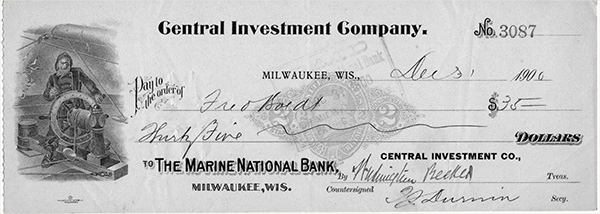
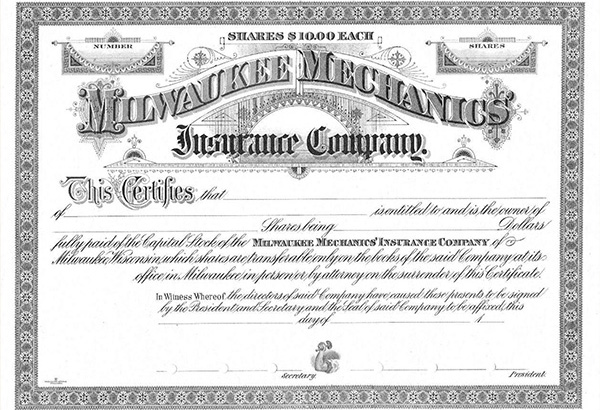
Another business that’s tied to numismatics is printing. Not the BEP, but private printing companies. These printers produce bank checks and stock certificates, which are collected by numismatists. The printer’s name will usually be printed on the front in the lower left corner. Some collectors form collections of checks or stocks from just one, and one in Milwaukee had some printing money privileges.
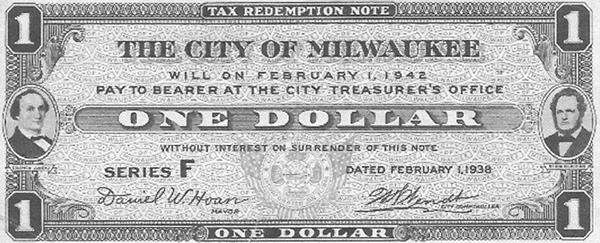
It wasn’t U.S. currency but Depression Scrip, which circulated like money, starting in 1933. Officially, the City of Milwaukee depression scrip was Tax Redemption Notes or “baby bonds.” The 1929 Depression was a tremendous hardship to the economy and the people who lived through it. There was high unemployment, with some banks closing. Some people lost their homes because they couldn’t pay their taxes. U.S. currency was hoarded, and there was a shortage of money to conduct business. The Gugler Lithographic Co., one of the largest in Milwaukee, obtained the contracts to allow them to print the depression scrip/baby bonds/redemption notes for the City of Milwaukee, Milwaukee Clearing House, and the state as well.
A few weeks ago, I attended a lecture at the Milwaukee Public Library presented by Sarah Finn on the Gugler Lithographic Co. I was thrilled to attend to learn more about the numismatic items they produced. Unfortunately, none were mentioned or shown. I was given out some historical information on the company, though.
The company was founded by German immigrant Henry Gugler. He studied art and worked in metal engraving before he emigrated to the United States in 1853 with his son Julius. He found work with a New York firm specializing in bank note engraving. By the early 1860s, he began working at the National Note Bureau, which later became the Bureau of Engraving and Printing in Washington, D.C., creating vignettes for financial documents of all kinds, including currency and bond certificates. The 1933 Milwaukee City Directory listed the company at 1339 N. Milwaukee St. with Oswald B. Gugler as President. Gugler’s work could be seen on paper money even into the 20th century, according to historian Harry H. Anderson, who notes that, “one vignette, showing a pioneer father, mother and child was used for the $5 United States Treasury note, series of 1869 and the, creating of $5 United States notes, series of 1875, 1878, 1880 and 1907 in addition.
He used the likenesses of his own family as models for this work. This note is nicknamed “The Woodchopper.” In 1878, Henry and his sons, Julius, Robert, and Henry Jr., started their own business. They specialized in stationery, envelopes, checks, billboard posters, and beer labels. One of their major customers was the Pabst Brewing Co. It is believed that Gugler handled all of the brewing giant’s advertising and promotional work as well as business blanks, stationery, and labels. By the early years of the 20th century, Gugler had more than 100 employees, and by World War II, it had grown into one of the largest printers in the state. When Ralph Gugler died in 1956, it ended nearly eighty years of Gugler’s control.
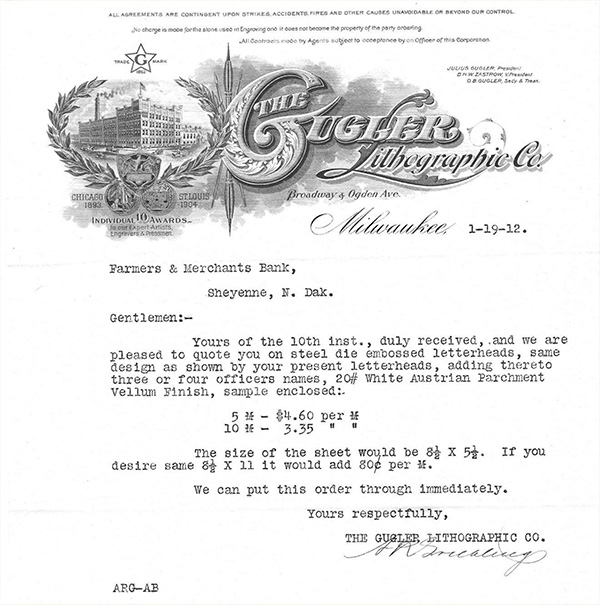
In 1973, the Gugler plant moved to 5100 W. Brown Deer Rd. The Gugler Lithographic Company celebrated its 100th Anniversary in 1978. The successor firm of Gugler was NorthStar Print Group, Inc. An example of their fine work can be seen on their ornate letterhead. Shown here are examples of the three different types of depression scripts that Gugler printed. They were like currency with serial numbers and signatures. Shown here are some of the products printed by Gugler.
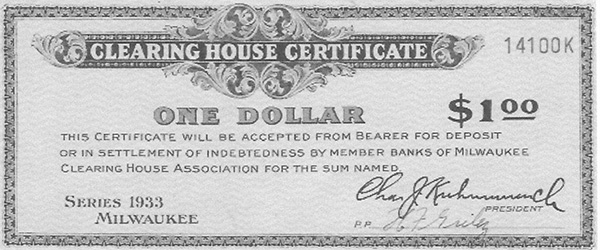
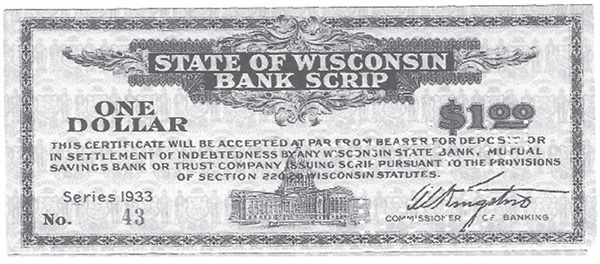
Thanks to Jim Downey for the supplied photos of the depression scrip.
For further reading on Depression Script, you can read the book, "Standard Catalog for Depression Scrip of the United States" by our beloved former MNS member, Neil Shafer, and Ralph A. Mitchell, and a good website is depressionscrip.com, too.
Have an interesting numismatic topic you’d like to share with your fellow NOW members?
Send your article to evan.pretzer@protonmail.com today!!!
