NOW Articles Written By Members
For more NOW Articles,
Find us on Facebook

Smallest of the small – Great Britain’s Copper Coinage
By Mark Benvenuto #2089
Volume 63 - Number 4 - Winter 2025
We have looked at the small change of France recently, and when the prices of silver and gold jump to new heights, we can still have a great deal of fun in our hobby, and learn a lot as well, if we focus on the low end of things, like copper.
Let’s do that a second time, now with the small change of Great Britain, simply because “smallest of the small” pretty much takes on new meaning when we examine the pre-decimal copper of the UK. First, let’s look at the cartwheel.
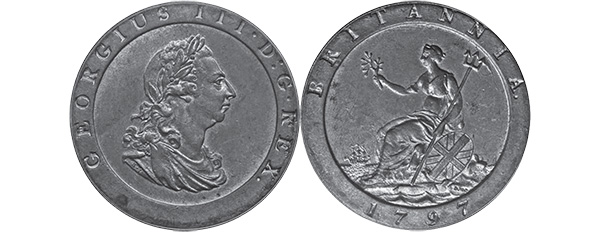
People who have been aficionados of British coinage know that the pre-decimal system had within it for one year a massive copper two-pence piece often called a cartwheel. Today, it is a coveted collectible, since it was only made in 1797, and has a wide range of values. The rim is amazingly wide, and often the value of a particular piece is based not only on its condition, but on the number of dings or blemishes on that rim.
It can be neat to get a good-looking cartwheel for any collection of copper we might assemble, wherever the other coinage comes from. But even though it is worth only 2 pence, it’s something of a stretch to call this small copper, at least based on its size.
Second, the big pennies.
What are now considered classic British pennies came out at the same time as the cartwheels, but managed to hang on far longer, certainly for longer than any large cents from the U.S. What can be considered a full run of British large pennies spans from 1797 all the way to 1970, although there are some changes along the way. The truly copper pieces were coined pretty continuously from 1806 up to 1859. After that, these got a bit smaller, and their composition was changed to bronze – generally 95% copper, 4% tin, and a single percent zinc. This was the state of things up until 1967, although the last hurrah for the penny was in 1970, when they were included in the final mint sets that were not decimal.
Plenty of the more recent dates among the British pennies can be found in dealer bargain bins, especially if they show significant wear. Some, going as far back as Queen Victoria, are still available very inexpensively, although they will routinely be worn. But good-looking pieces are not really all that expensive.
Supplied photo. P.C.G.S.
Third, smaller than a penny – half pennies and farthings.
Britain has a long tradition of half-penny coins, as well as farthings, little pieces that were valued at one-fourth of a penny. A bit of math is in order here to give us some perspective on a coin like the farthing. A British pound was made up of 20 shillings. In turn, a shilling was made up of 12 pence. That meant we needed 240 of these large pennies to make a pound, or 480 half-pence to make one. Now, since 4 farthings were needed to make just one penny, that meant 960 farthings were needed to make a pound! We can only wonder if anyone actually tried to pay for some item with 960 of these little guys. Curiously, the farthing made it as a circulating coin all the way to 1956. It seems like there must have been some inflation pushing against it during these later years, simply because its nominal value was so low. In 1961, by law, it was no longer legal tender.
As with British pennies, there are plenty of half-pennies and farthings to be found in well-stocked dealers’ holdings, and quite a few available through online sellers. Those of the 20th century tend to be very inexpensive. But as just mentioned, some of those of Queen Victoria are reasonably priced as well. A collection of half-pennies or of farthings would indeed be small, but could still be fun.
More fun, smaller than a farthing.
Okay, here is where we go from small coins that might raise an eyebrow to tiny denomination coins that qualify as jaw-dropping. For a brief time in the nineteenth century, Great Britain actually produced ½ farthing coins, 1/3rd farthing coins, and even ¼th farthing coins. A little bit of digging tells us that these were not made for Great Britain itself, but rather for colony lands such as Ceylon. The ½ farthing pieces were issued from 1828 – 1856, and in 1842 were made legal in Great Britain proper. The 1/3rd farthing pieces had a run that went from 1827, all the way up to 1913, with some vacant years in that stretch. These were apparently supposed to see use in Malta, when it was part of the Empire. But they, too, saw some use in Britain. The tiniest of the tiny, the ¼th farthing pieces, were only made for a few years in the middle of the 1800s, and again were made for use in Ceylon. Apparently, Ceylon used British coins enough that these were accepted on the distant island. If we continue our “math lesson” as it were, it would take 3,840 of the ¼th farthing pieces to make a pound. It boggles the mind to think of someone trying to tally all this up, if indeed it ever happened.
Today, these tiny coppers are still available, but we might have to do a bit of searching to find any of them. Because they all have some history to them, these tiny pieces can be more expensive than we might at first think. Most folks think that coins like this might cost no more than a dollar or so, and thus would be surprised to see price tags like $50 attached to any of them, even if they are in excellent condition. But their rarity and age do command some sort of premium.
Whether we opt for these oldest and smallest of the small, or stick with more modern small pieces – including the ½ penny, which made it as a decimal coin until 1984 – there is plenty from which to choose when it comes to small, British copper. Why not have some fun and see what we might be able to assemble?
Have an interesting numismatic topic you’d like to share with your fellow NOW members?
Send your article to evan.pretzer@protonmail.com today!!!
