NOW Articles Written By Members
For more NOW Articles,
Find us on Facebook

The Fords and a Coin Collector’s chance Encounter
By Steven Bieda
Volume 63 - Number 4 - Winter 2025
Editor’s Note: While Mr. Bieda could not confirm he is a N.O.W member, I do take guest articles now and then, which I think readers may find interesting.
Legislated by Public Law 109-145, the Presidential $1 Coin Program was limited to deceased presidents, with the provision that there is at least a two-year period following the date of the death of the president before a coin can be issued. Having had an opportunity to meet and talk with both President and Mrs. Ford, this numismatic issue has a little more personal meaning to me than the previously issued coins in the series. Ford was this nation’s only non-elected president, and this article will share the author’s personal story on his meeting with the former president and first lady, as well as a look at their coin canon.
The Meet:
I had the opportunity to meet with former President Gerald Ford at the site dedication of the Gerald R. Ford School of Public Policy on September 18, 2003. The former president spoke to an auditorium of about 1,000 people. Afterwards, I was invited to lunch with regents from the University of Michigan and the former president, with probably about 60 people, a mix of Republican donors, elected officials from both parties (I was a freshman Democratic State House member at the time), and University officials. I was fortunate to sit with then-Congressman John Dingell (who went on to be the longest-serving Congressman in U.S. history) and his wife and future U.S. Representative, Debbie Dingell.
After sitting for a couple of minutes and enjoying the company of the table, the former president came into the room and took an adjoining table, probably less than 10 feet away. I had a copy of the dedication booklet that was given to all the participants, and I summoned up the courage to approach the former president to ask if he would autograph it for me. I was, however, somewhat conflicted about going up and speaking to the former president, who was sitting at a table of high-powered luminaries. My desire to get an autograph overcame my very strong desire not to look like a tourist, and I approached the former president and asked for his signature. On reflection, I thought it odd that I was the only person in the room to do so, although I have to note that the vast majority of the luncheon guests were luminaries from national politics who had worked with and known the former president for years. Anyway, I probably talked with President Ford for about five or so minutes, and I found him to be very personable and very genuine.
He asked me questions about my district, my first race, and he also asked me about what committees I served on, and he seemed very familiar with my district. I also told him I saw him when I was a kid, while he was campaigning for re-election, and visited Macomb Mall in Roseville, Michigan. After he graciously autographed my program, I thanked him and returned to my seat. Of course, right after I did, former first-lady Betty Ford came into the room. Now I had a quandary. While the former president had been super friendly and very approachable, I didn’t want to make a pest of myself. I did the same mental contortions, but ultimately decided that if I didn’t ask now, I would never have a chance to get Betty Ford’s autograph. Thus, after several minutes of back-and-forth ministrations in my head, I decided to go ask for her autograph as well.
This time, the former president saw me come up, and before I could speak, he introduced me to his wife and repeated some of the conversation that we had had moments before, in particular the amount of money my campaign committee spent in the 2000 race. The former first lady was most gracious, and after signing the program, I thanked them both for their kindness and returned to my seat. After lunch, I decided (perhaps my inner stamp collector kicked in) that I needed something to verify when I had the program autographed. It may also have been due to my legal experience; lawyers often get certain legal documents “time-stamped” to prove when a particular document was submitted to the court.
In any event, I decided to take it to the Ann Arbor Post Office, aptly named the Liberty Post Office, and after buying the appropriate amount of postage, had the dedication pamphlet carefully hand-stamped. I didn’t see the former President signing anything at this event, and with both signatures and the postmark, I’m sure it’s the only one out there like it. Today, it is a cherished piece of political memorabilia I’ve kept in a place of honor at various times in my office or home.
The Presidential Dollar:
Since the program’s inception in 2007, the U.S. Mint has produced and issued four Presidential Dollar coins per year, each with a common reverse design featuring a striking rendition of the Statue of Liberty. The program was authorized by the Presidential $1 Coin Act of 2005 (Public Law 109-145), the engrossed bill was sponsored by U.S. Senator John E. Sununu (R-New Hampshire). One of the goals of the Presidential Dollar program was to increase the circulation of the small-sized dollar coin by increasing public interest and attention in the denomination. However, the program never reached the same level of popularity as the more popular “State Quarter” program, as production and circulation of the paper dollar note continued unabated. Thus, as inventories of Presidential and Native American Dollar coins mounted, in December 2011, then Secretary of the Treasury Timothy F. Geithner directed that the U.S. Mint suspend the minting and issuing of circulating Presidential One Dollar Coins.
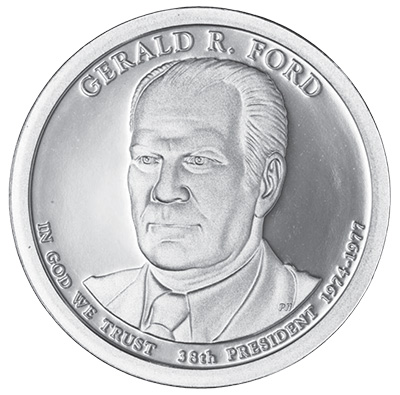
With huge stockpiles of earlier Sacagawea and Presidential dollars remaining, demand for the regular circulating needs for the coins has been met through the Federal Reserve Bank’s existing inventory of circulating coins minted before 2012. The U.S. Mint, however, was directed to continue to offer several products that contain Presidential $1 Coins, including mint sets, uncirculated rolls, and proof sets. Thus, beginning with Presidential Dollars beginning with President Chester A. Arthur, the mintages of these coins were significantly lower than previous issues. The Gerald Ford Presidential Dollar was designed and sculpted by United States Mint Sculptor-Engraver Phebe Hemphill. The inscription on the obverse includes the president’s name, term in office, the order in which he served, and “IN GOD WE TRUST.” The reverse of the coin features a rendition of the Statue of Liberty, which was designed and sculpted by U.S. Mint engraver Don Everhart. The Inscriptions on the reverse include “$1” and “UNITED STATES OF AMERICA.” The year of minting, the mintmark, and “E PLURIBUS UNUM” are incused on the edge of the coins. The coin’s diameter is 26.49 mm.
Supplied photo. P.C.G.S.
The coins were minted at Denver and Philadelphia for the circulation quality strikes. Proof examples were struck in San Francisco. The mintmarks for each of the respective facilities appear on the edge of each coin. As a somewhat gap in a mini-series of the Presidential Dollar coin, no reverse proofs were struck of the Ford coin, even though special reverse proof examples were struck of the Truman, Eisenhower, Kennedy, Johnson and Reagan presidential dollars all bearing the P mintmark and only available in the Presidential Coin & Chronicles set (a reverse proof would later be struck for George H.W. Bush after his passing in 2018). In another gap in the Presidential Dollar series, the Ford Dollar was followed by the President Ronald Reagan Dollar, as the authorizing legislation only allowed for coins to be struck honoring deceased U.S. Presidents. The Reagan Dollar is the final coin issued in the series as it was originally authorized.
For the President Gerald R. Ford Dollar, the U.S. Mint began sales of circulating quality examples of the coins on March 8, 2016. Product options included 25-coin rolls, 250-coin boxes, and 100-coin bags from either the Philadelphia or Denver Mint facilities. These products were priced at a slight premium to face value, with the 25-coin rolls of either “P” or “D” mintmarks selling for $32.95, 100 coin lots at $111.95, and 250 coins at $275.95. As with recent prior releases of the series, the Gerald Ford Presidential Dollars were not released for general circulation, but were only available within numismatic products sold by the US Mint. I’ve run across a couple in mixed bank rolls from the bank; thus, finding a lightly circulated example this way is not totally out of the question for collectors
Throughout the year and into 2017, the Ford coins would be included in other numismatic products. A proof version struck at the San Francisco Mint and carrying the “S” mint mark was included within the 2016 Proof Set, 2016 Silver Proof Set, and 2016 Presidential $1 Coin Proof Set. Uncirculated versions were incorporated into the 2016 Uncirculated Coin Set, 2016 Presidential $1 Uncirculated Coin Set, 2016 Annual Uncirculated Dollar Coin Set, and Presidential $1 Coin and First Spouse Medal Set. The Mint recorded 5,460,000 coins struck at the Philadelphia Mint, and 5,040,000 from the Denver Mint.
Total San Francisco proof coin mintage was 1,112,545, with the proof coins appearing in the three aforementioned collecting options: The Presidential $1 Coin Proof set (consisting of Presidents Nixon, Ford, and Reagan) with a production of 231,558, the traditional clad proof set, with a production of 546,067, and the special silver sets, with 334,920 produced. Other than the packaging, there is nothing to differentiate the coins appearing in any of the trio.
Mrs. Ford’s Monetary Legacy:
Pursuant to the same authorizing legislation of the Presidential Dollar series, the United States Mint has minted non-circulating $10 denomination gold coins honoring former first spouses of the United States by issuing one-half ounce $10 gold coins featuring their images in the order they served as first spouse. These coins are issued on the same schedule as the Presidential $1 coins honoring the presidents. Originally, the intent was to utilize the ten-dollar denomination, which would have utilized the quarter-ounce American Eagle planchet. Some in Congress were concerned, however, that the smaller planchet might cause unnecessary offense to women; thus, Congress authorized a first spouse coin with a diameter identical to the 26.49 mm circulating dollar coin. Thus, a larger half-ounce planchet was authorized. However, the drafters ultimately failed to change the denomination to be consistent with those of the American Eagle program.
So instead of the twenty-five-dollar denomination of the Half Ounce American Eagle program, the First Spouse gold coins have the Ten Dollar denomination rather than the twenty-five-dollar denomination. Not that it matters much, as these coins are sold for bullion-based prices, which are considerably higher than the nominal face value. Sadly, the larger diameter and gold content raised the prices of these gold coins considerably. Especially since, at the passage of the legislation, gold was trading at an average price (for 2005) of $444.75 an ounce. In the first year of the program in 2007, gold hit $841.10 an ounce, with a low of the year at $608.40. Since that time, gold has hit several records, and when I wrote this, gold was trending around $3,400-3,500 an ounce and has risen since.
The obverse side of the First Spouse Gold Coin features portraits of the first spouses and inscriptions of their names, the order and years of their term as first spouse, the year of minting or issuance, and the mandatory inscriptions, IN GOD WE TRUST and LIBERTY. Each coin has a unique reverse design featuring an image emblematic of that spouse's life and work, as well as the inscriptions UNITED STATES of AMERICA, E PLURIBUS UNUM, $10, 1/2 OZ., and .9999 FINE GOLD. When a president served without a first spouse, a gold coin is issued bearing an obverse image emblematic of Liberty as depicted on a circulating coin of that era and a reverse image emblematic of a theme of that president's life. The coin is inscribed with the years and order of that president's term, like dollars.
First Spouse Bronze Medals in the 1-5/16 size have been issued as well. They bear the same central images as the gold coins and are also inscribed with the name of the first spouse and the order and years of their term as first spouse. The “Liberty” obverse designs are inscribed with the years and order of the president's term. The bronze medals were issued to provide collectors of more moderate means a more affordable option. These medals are the first United States Mint product to duplicate designs from a contemporary coin series. The medals were sold as a two-piece set, each including an example of the corresponding presidential dollar, and were struck at the Philadelphia mint and priced at $9.95. The total production for the Ford dollar and the Betty Ford Medal was at 7,198.
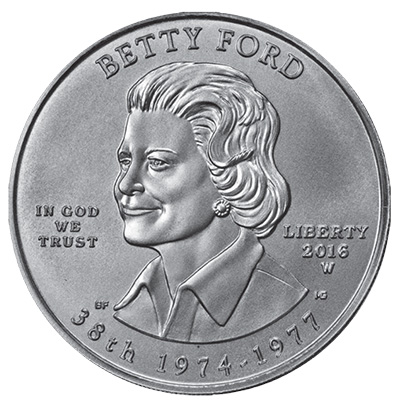
The obverse of the Betty Ford First Spouse gold coin was designed by Barbara Fox and engraved by Michael Gaudioso. It features a three-quarters bust of the former first lady facing the viewer’s left. The reverse design of the Betty Ford First Spouse coin was designed by Chris Costello and engraved by Renata Gordon. The half-ounce gold coin was first offered on the United States Mint web page on March 25, 2016, with the initial issue price of $795 for the uncirculated and $815 for the proof. It was offered on the U.S. Mint’s website through 2017.
Supplied photo. P.C.G.S.
According to the United States Mint’s press release, the reverse design “features a young woman ascending a staircase, representing Mrs. Ford’s openness and advocacy regarding addiction, breast cancer awareness, and the rights of women.” During her tenure as first lady, Betty Ford had battled breast cancer, and her openness in dealing with the disease brought it to the forefront of the public’s attention. Betty Ford was also a feminist and openly supported the Equal Rights Amendment to the United States Constitution. Perhaps she is best known, however, for her significant and very public fight against addiction, a personal problem that she later would not just overcome, but would be a very public crusader against, ultimately with her leadership to start the Betty Ford Clinic.
The mintage figures for the Betty Ford First Spouse gold coin reflected the decline in collector interest from when the program first started with the sell-out of the Martha Washington first spouse coin in 2007. The Martha Washington coin recorded healthy mintages of 17,661 uncirculated examples and 19,167 proof examples, and the highest mintage coin of the series, the Jefferson-Liberty 2007 coin, which recorded 19,823 uncirculated examples and 19,815 proof examples.
New programs usually see a spike at the beginning, with declining interest as the program matures. Significantly higher gold prices and largely poor performance on the secondary market undoubtedly contributed to the decline in sales. According to the U.S. Mint’s report a month after the close of sales, the Betty Ford First Spouse coin, as of January 21, 2018, recorded 1,827 uncirculated examples and 2,484 proof examples. The uncirculated coin is clocking in as the lowest mintage piece in the entire series, making it the “key” coin for the series.
Subsequent Issues:
With the passing of George Herbert Walker Bush on November 30, 2019, and the previous passing of former first lady Barbara Bush on April 17, 2018, Congress authorized the striking of a Presidential Dollar and First Spouse Ten Dollar coin commemorating the senior Bushes. The 2020 dated Dollar had a mintage of 1,245,275 from Philadelphia, and 1,502.425 from Denver. No proofs were struck; however, 35,000 reverse proof examples of the George H.W. Bush Dollar coins were then produced for inclusion in the Presidential Coin & Chronicles coin sets.
The Bush Presidential Dollar is still available on the United States Mint website, being offered at $304 per box of 250 coins. The Barbara Bush gold coin had a mintage of 2,952 proofs and 1,967 mint state examples issued, somewhat higher than the Betty Ford mintages. The passing of Jimmy Carter on December 29, 2024, opened up the possibility of a Jimmy Carter Dollar and a gold coin honoring Rosalynn Carter, who predeceased him on November 19, 2023, although as of this writing, the Mint has not been authorized to produce a coin for America’s longest-lived President. Carter’s place in the Presidential Dollar series is the “Gap” between the Presidencies of Gerald Ford and Ronald Reagan.
Both George H.W. Bush and Jimmy Carter, incidentally, had lives intertwined with those of the Fords. Jimmy Carter won the Presidency in the 1976 election, narrowly beating out Ford. The two would famously become best friends later in life, with Ford asking that Jimmy Carter deliver a eulogy at his funeral. Carter, although he outlived Ford by 18 years, had similarly asked Ford to do the same for him; Ford’s eulogy for Carter, written many years before Ford’s death, was actually delivered at Carter’s funeral by Gerald and Betty’s son, Steve – ironically on the 18th anniversary of Carter delivering his eulogy for President Gerald Ford.
Somewhat forgotten today, but at the 1980 Republican Convention in Detroit, the Republicans floated the idea of former President Gerald R. Ford joining the ticket as Vice President to Ronald Reagan. This, of course, did not happen, as reportedly Ford envisioned more of a new co-presidency with Reagan. Instead, the office was ultimately accepted by fellow Republican, George H.W. Bush.
Conclusion:
While the Ford presidency was short, the inherent decency of the Fords, coming in the wake of Watergate and the end of the tumultuous war in Vietnam, served to help heal a nation. The coins issued in their honor commemorate two very special people who held a very special place at a unique time in our nation’s history. Having had the opportunity to meet this gracious couple, for this collector at least, these coins have a special connection that will never fade.
Supplied photo. P.C.G.S.
Have an interesting numismatic topic you’d like to share with your fellow NOW members?
Send your article to evan.pretzer@protonmail.com today!!!
