NOW Articles Written By Members
For more NOW Articles,
Find us on Facebook

What Goes UP Must Come Down
[Tom Casper #0982]
Volume 64 - Number 2 - Summer 2026
Recently, I purchased an old, used book titled “Riverview: Gone but not Forgotten: 1904-1967.” The book was written by Chuck Wlodarczyk and published by Riverview Publications in 1977. It brought back memories of my teenage years. I was happy to find the book because I visited this amusement park way back in 1961. It was billed as the “World’s Largest Amusement Park.” If you are somewhat familiar with Chicago, their address was 3300 N. Western Ave.
I drove to the large, thrilling park with my girlfriend at the time, who later became my wife, and another couple of friends. It was your typical old amusement park with many rides and games. There was a lot to see along the 2.5-mile midway. Three of their famous wooden roller coasters were named “The Bobs,” “The Flash,” and, of course, there was “The Fireball.” The Bobs was considered the top-tier ride, and its first hill was 85’ high with a steep drop.
Most amusement parks had roller coasters at the time, but one ride they did not have was the Pair-O-Chutes, like Riverview. The Pair-O-Chutes was the tallest structure in the park, rising 212’ above the ground. The structure was originally an observation tower, but in 1937, it was converted to this ride. It was the first free-fall parachute ride to be built. Although I was not a fan of heights, of course, I wanted to impress my girlfriend, so my buddy and I boldly partook in the ride.
We were strapped into the seat with our legs dangling below us. Knowing this was an old ride, I wondered if this seat would hold both of us and what might happen if it failed. The ride began, slowly pulling us up and affording a panoramic view of the park and beyond. The parachute above us blocked us from seeing the top, which was 196’ high. Then suddenly, the parachute was released, and we did a free-fall for a distance until the parachute opened and slowed our descent. I was never so scared before. Although it was exciting, I vowed deeply to “never again.” The book pictured two different tokens used in the park and said that tokens were used before they changed over to coupons, but no year was given. It reminded me of three Riverview tokens in my collection. All these tokens were probably used on the midway because some have a denomination on them and would be considered trade tokens. None of them mentions the word ride so they would not qualify as transportation tokens. Here are the three that I have here at my home:
1. Riverview Park/One Free Trial/Same Rd., WM 25mm TC-595472, center hole as made.
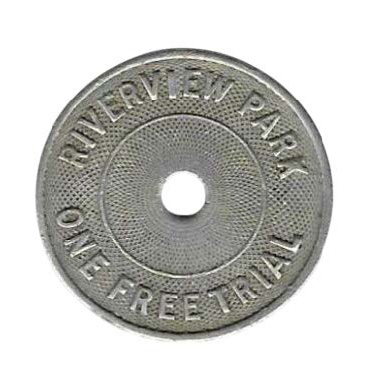
2. One Free Trial/Riverview Park/R.P./Same Rd. WM 25mm TC-482000, cstp. w/5 Xs.
3. Special 2c Saturdays/At/Riverview/Are/From May 20th to June 17th Incl.//Good for Admission/On Any/2c/Saturday/To Riverview Rd. Cop. 31mm TC-149295 Date of 1939 scratched in.
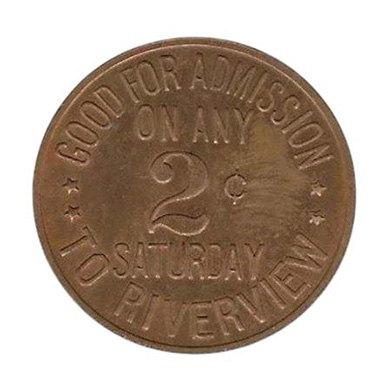
Ore H. Vacketta, in his 1983 book, “Trade Tokens of Illinois,” lists 6 different Riverview tokens. The Token Catalog lists 8 different Riverview tokens. For TC-482000, the Token Catalog lists 11 letter counterstamps: C, H, I, J, U, U&K, W, X, Y, ZO, ZB. Affordable pieces, and, certainly for me, the memories are priceless.
Tom Casper has been collecting coins since 1953, but in 1967, he changed to collecting tokens and medals. He enjoys history and will occasionally write articles on pieces from his collection.
Have an interesting numismatic topic you’d like to share with your fellow NOW members?
Send your article to evan.pretzer@protonmail.com today!!!
