NOW Articles Written By Members
For more NOW Articles,
Find us on Facebook

Smallest of the Small – the Small Change of a Small Nation, Belgium
[Mark Benvenuto #2089]
Volume 64 - Number 1 - Spring 2026
As with many European nations, when the Euro came into existence, Belgium managed to get on the team, became part of the Eurozone, and started issuing its own Euros. But before that adoption, Belgium used its own franc coins, with 100 centimes being equal to one franc. With the price of silver metal having crossed the $60 per ounce line in 2025, looking at the small change of Belgium might provide a welcome and enjoyable relief from the price of precious metal coins. Let’s take a peek at the smallest of the small when it comes to the coins of Belgium.
Copper, 1-centime:
Belgium has an ancient history, and was known to the Romans, who eventually conquered it and the surrounding area. But Belgium does not have nearly as long a history when it comes to being an independent, modern nation. It had briefly been part of the Netherlands until its independence in 1830, when it seems that most of the citizens wanted nothing to do with their northern neighbor. Instead, in creating a monetary system, they opted for a franc instead of something more Dutch-sounding, like a guilder. That franc could be divided easily into 100 centimes. The smallest of the coins became a little, copper 1-centime piece.
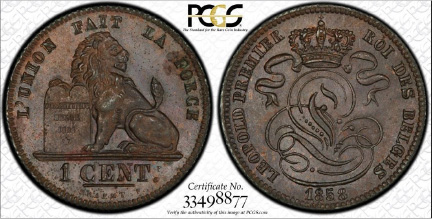
As might be expected, the first king of the Belgians, Leopold I, has some mention of himself on these small coppers. A rather ornate “L” dominates one side, while the Belgian lion is the prominent feature of the other. As might not be expected, King Leopold did not cut and slice his way to the monarchy as some war hero. Rather, he was asked to take the throne by those already in power in Belgium, and so a son of the house of Saxe-Coburg-Saalfeld ended up with the top job for a newly independent nation.
The copper 1-centime coins kept coming out with Leopold’s monogram for quite a few years, decades really, since his son was also named Leopold. Leopold II took the throne in December of 1865 and held on all the way to 1909. While that doesn’t beat the length of the reign of Britain’s Queen Elizabeth, it is certainly long enough that there was quite a pile of coins made with his name, image, or monogram.
Supplied images. N.G.C./P.C.G.S.
For those of us who want the smallest group of Belgian one-centime pieces, ignoring small variations, one piece that says, “Leopold Premier” and one that states, “Leopold II” ought to do the trick. But it could be a fun challenge to see just how many years are still available, and how little each might cost. We could, of course, add one more, a centime with the “A” monogram of Albert I on it, as he was third on the throne, a grandson of Leopold I.
For the person who wants a set of all these small coppers, they range from 1832 to 1914. There are several years when none were issued, but through it all, the design tends to change only when a new king takes charge.
Moving up to 2-centimes:
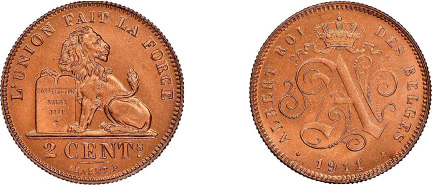
As with virtually all the series of small change we have looked at, there are a few slightly larger denominations that we can look at when we start with the smallest of the small. In the case of Belgium, and its small change, there was also a 2-centimes coin, issued from 1833 up to 1919, again with some years of no production.
Supplied images. N.G.C./P.C.G.S.
The 2-centime coins of Belgium look so much like their little siblings that we can be excused for confusing the two, especially if each has darkened severely over the course of time. The design elements are virtually the same, from the large, ornate monogram to the seated Belgian lion. The only real difference is in the exergue under the lion. One proclaims “1 CENT.” while the other states, “2 CENT.” Perhaps obviously, the size of the two coins differs as well.
The 5-centime and 10-centime coppers:
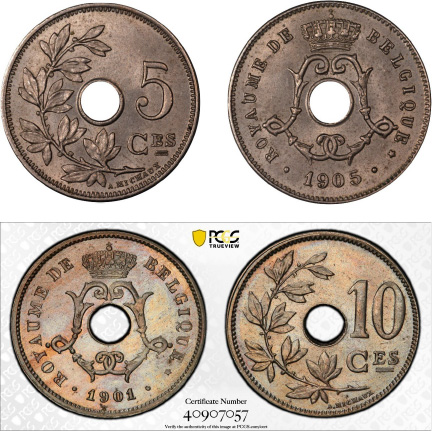
A full view of all the Belgian small coppers would include the 5-centimes and the 10-centimes pieces as well, although we can debate whether or not 10-centimes qualifies as small. After all, this is basically the “dime” of the Belgian franc system. We’ll include it here, though, because the design is virtually the same for all four of these small change denominations.
Supplied images. N.G.C./P.C.G.S.
Where there is a big difference in the 5-centime and 10-centime coins, at least when compared to their smaller pals, is that these larger two survived for a longer period of time, moved to new designs with a center hole, and ultimately ended up being made of zinc. It is sometimes a surprise to find that the zinc pieces, when in excellent shape, can be costly. That is because zinc is a rather active metal, meaning it reacts with just about everything around it. Thus, zinc can quickly tarnish or develop a whitish coating. Collectors who want spotless coins will tend to pay a bit more for zinc pieces that have no blemishes.
Overall:
Whether we decide to try to collect all the small change of Belgium up to the 10-centimes pieces, or just stick to the 1-centime coins, one other interesting aspect of the coins of Belgium is that there always seem to be two versions. They can be found with French legends, such as “Des Belges” on them, or their Flemish equivalent, such as “Der Belgen.” Both are written after the monarch’s name, and both translate to “of the Belgians.” This is a compromise used in Belgium because there are Flemish speakers in the north and French speakers in the south. For our purposes, it gives us a somewhat wider group to collect, which we hope means more fun.
As mentioned, the small change of Belgium evolved into the Euros and Eurocents, as did the coins of several other nations. But they can still be an intriguing challenge for the modern collector.
Mark Benvenuto has been collecting since the 1960s and became seriously interested in the silver coins of pre-World War II Germany when he was stationed in Mannheim in the 1980s.
Have an interesting numismatic topic you’d like to share with your fellow NOW members?
Send your article to evan.pretzer@protonmail.com today!!!
