NOW Articles Written By Members
For more NOW Articles,
Find us on Facebook

Smallest of the Small: The Centavos of Peru
[by Mark Benvenuto #2089]
Volume 64 - Number 2 - Summer 2026
In past articles, in looking at the small denomination coins of a variety of nations, we have inadvertently stayed away from the nations of South America. We’ll take the blame for that, but will also get on board with it, by taking a look at a nation that has both a richly varied history as well as a true wealth of minerals – Peru.
Those of us who have delved into what gets called Spanish colonial coinage know that two of the big producers throughout the past five centuries have been Mexico and Peru, once known as the Viceroyalty of New Spain and as the Viceroyalty of Peru, respectively. Both lands minted a river of silver and gold, but we never hear much about their copper coinage. This is because the economy of Peru, for example, could function pretty well using only the two most precious metals.
If we skip forward a couple of hundred years from the Spanish conquest, Peru underwent a long and bloody war for independence, lasting from 1811 to 1826. It was not just Peruvians versus the Spanish, but rather, several fights were going on among factions within the new nation as well. It took some time after that to come up with a monetary system that did not simply parrot what the Spanish had used before the war, and so it was quite a while before we saw the centavo at all.
In the 1860’s, a system was adopted in which 10 centavos equaled one dinero. In turn, 10 dineros were equal to one sol. And ten soles were equal to one libra. As we might imagine, by the time one is talking about libras, we are talking gold.
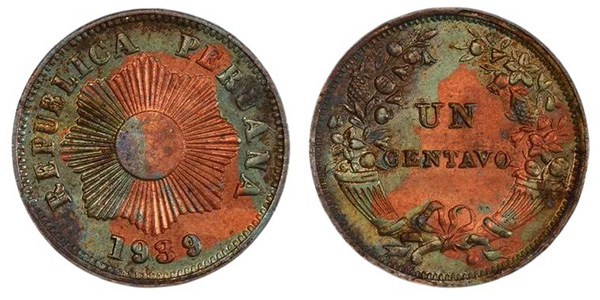
Supplied photos. P.C.G.S
The one-centavo came off the starting line in 1863, as a copper-nickel coin. One side is dominated by a stylized sun, while the reverse is much like U.S. one-cent coins, meaning the stated value is surrounded by a wreath. That stylized sun has become a national symbol of Peru and represents the Inca god Inti. This symbol is connected to the archaeological treasure and breastplate that is the Echenique Disc, and represents fertility and life, as well as personal and national power.
In just a couple of years, it seemed there was little need for more one-centavo coins, as there is a break from 1865 all the way to 1875. From 1875 to 1878, there were one-centavo coins minted, now in bronze, then a break again until 1886.
As we might imagine, these littlest pieces of an independent Peru are not exactly dirt cheap, but they don’t cost a fortune either. In keeping the cost down, we have the factor that not many folks try to collect them. In bumping the prices up, we have the cold, hard fact that not all that many were produced in the first place.
What we might call the much more common one-centavo coins get their start in 1901, and don’t really have much by way of a design change. But curiously, from 1901 to 1941, there is a thick planchet variety, as well as a thin planchet variety. The thin ones had a longer lifetime, going all the way to 1949. Neither variety was minted annually, so for any of us wanting to assemble some sort of date run, there will be a couple of hefty gaps in the string of years. There is even a key date in the series, 1933, which saw a much lower mintage than any of its peer years. But again, because the collector base is thin, even this date is not very expensive.
As with the small change of many nations, the one-centavo pieces felt the pinch of inflation, and in 1950 evolved to a little zinc piece. These were produced from 1950 up to 1965, with only 1964 missing from the mix. That stylized sun of Inti is still the main feature on one side, while the value and wreath change only a bit on the other. These came off the minting machinery in remarkably large numbers, which is convenient for anyone trying to build a collection today. Indeed, since these are very small and are zinc, they can sometimes still be found in dealer bargain bins. To defend our comment that these are “very small,” it can be fun to compare one to the much more famous Panama pill – a 2½ centesimos silver piece of 1904 that Panama used, which is only 10mm in diameter. The zinc one-centavo measures only 14mm in diameter, which is not too big a difference.
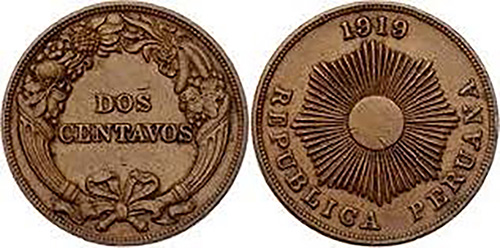
Supplied photos. Numista
The one-centavo slid into oblivion in 1965, as did its larger sibling at about the same time, the two-centavo piece. The five-centavo and ten-centavo pieces ended up being the smallest of the small change for another decade. Curiously, the last of the ten-centavo pieces were brass coins that are almost the same size as the final one-centavos that went before. These last ten-centavo pieces have a diameter of basically 15mm. They, too, should be easy to pluck from some bargain bin, at least if we are patient enough to hunt around for them.
Peru went through a monetary reform in 1990 to fight back against hyperinflation. After that change, in 1991, the money was termed a Nuevo Sol, making the traditional small change a thing of the past. But there are still quite a few of the older one-centavo coins out there for any collector wanting a challenge.
Mark Benvenuto has been collecting since the 1960s and became seriously interested in the silver coins of pre-World War II Germany when he was stationed in Mannheim in the 1980s.
Have an interesting numismatic topic you’d like to share with your fellow NOW members?
Send your article to evan.pretzer@protonmail.com today!!!
