NOW Articles Written By Members
For more NOW Articles,
Find us on Facebook

The Top 100 Large-Size Bank Notes
[by Matt Janzen #2082]
Volume 64 - Number 2 - Summer 2026
Yes, the title is a little misleading. We aren’t talking about the best or rarest 100 notes. Instead, let’s look at Wisconsin national banks with more than 100 surviving large-size notes known today (issued before 1929). Only six issuing banks — plus one honorable mention — make the list.
Starting with the honorable mention at 99 surviving notes is The National Exchange Bank of Milwaukee, charter number 1003. Chartered on April 12, 1865, it was one of Wisconsin’s earlier national banks. After a 65-year run, the bank consolidated with and was absorbed by The Marine National Bank. The bank issued Original, 1875, 1882, and 1902 series notes, although no 1875s are currently known. Most surviving examples are 1902 Plain Backs.
Coming in at number six with 105 surviving notes is charter number 6015, The Commercial National Bank of Fond du Lac. Chartered on November 9, 1901, the bank operated for just 33 years before entering receivership on January 2, 1934. Both the 1882 and 1902 series were issued, with 1902 Plain Backs outnumbering the 1882 issues by roughly three to two. The bank was succeeded by the National Exchange Bank, which did not issue notes.
At number five, with 128 surviving notes, is The LaCrosse National Bank, charter number 2344. Chartered on December 1, 1876, the bank was liquidated less than 20 years later and succeeded by charter number 5047, The National Bank of LaCrosse. Although the bank issued only 1875 series notes, survivors are surprisingly plentiful due to a hoard that was saved years ago and eventually entered the collector market. Surviving notes are split fairly evenly between $1s and $2s, with just a single $10 and $20 known.
Number four on the list is charter number 4817, The Wisconsin National Bank of Milwaukee, with 147 surviving notes recorded. Along with the LaCrosse National Bank, this was another bank that issued only large-size notes. Chartered on November 12, 1892, it absorbed The Central National Bank (charter 4816) before eventually consolidating into the newly formed First Wisconsin National Bank of Milwaukee in July 1919. The bank issued both 1882 and 1902 series, with 1882 notes outnumbering the 1902 issues by roughly five to two.
Breaking into the top three with 174 known notes is The Germania National Bank of Milwaukee, charter number 6853. The bank’s original ethnic name reflected Milwaukee’s strong German heritage, but sentiment shifted following the United States’ entry into World War I. In June 1918, the bank adopted the more acceptable title, The National Bank of Commerce. Although the bank issued only 1902 series notes, all three types — Red Seals, Date Backs, and Plain Backs are known. Most survivors are Plain Backs under the second title, though two rare $100 Red Seals are known bearing the Germania title.
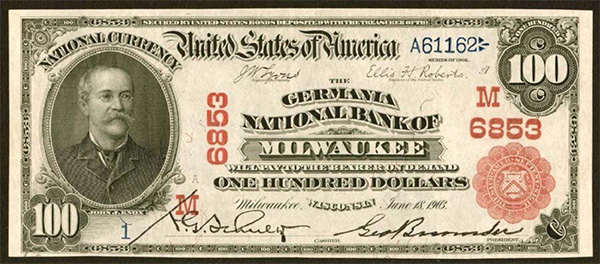
Supplied image.
Continuing Milwaukee’s dominance on the list, number two is charter number 5458, The Marine National Bank. Chartered on June 26, 1900, the bank consolidated with The National Exchange Bank in 1930 and became The Marine National Exchange Bank. Unlike many note-issuing banks, it continued operations long after the national bank note era and eventually merged into Bank One in 1996. The bank issued both the 1882 and 1902 series before transitioning into small-size notes, and 252 surviving large-size notes are currently recorded.
The First National Bank of Milwaukee holds the top spot. Wisconsin’s oldest national bank was chartered on August 15, 1863, and operated under charter number 64 until 1882. Because national bank charters were originally granted for 20-year periods, many early banks mistakenly believed they needed to apply for an entirely new charter upon renewal. As a result, charter 64 was dissolved in 1882 and replaced by a new First National Bank under charter number 2715, which itself narrowly misses this list. In 1911, charter number 64 was reassigned to the bank. Under the later title First Wisconsin National Bank, it absorbed no fewer than eight other banks by 1933 before eventually merging into Firstar Bank in 1999. Notes issued included Original, 1875, and 1902 series, while 1882 notes were issued under charter 2715. Of the surviving notes, 69 bear the original title, while an impressive 324 carry the second title. These “Top 100” banks provide collectors with an opportunity to pursue a wide variety of large-sized national bank note types and denominations, often with far more availability than one might expect.
Matt Janzen has been collecting coins since 1974. He now specializes in collecting tokens from Sauk County and collecting small-sized Wisconsin national bank notes. He also maintains the WI national bank note census.
Have an interesting numismatic topic you’d like to share with your fellow NOW members?
Send your article to evan.pretzer@protonmail.com today!!!
