NOW Articles Written By Members
For more NOW Articles,
Find us on Facebook

Coin Collecting Cousins
[by Mark Benvenuto #2089]
Volume 64 - Number 3 - Fall 2026
It doesn’t take a new collector too long to find a coin series or two that he or she likes. Plenty of us gravitate towards big silver coins of the United States; some of us like classic series, some modern, while others opt for a foreign coin set from someplace special to them. As we get deeper and deeper into our hobby and it becomes a passion, we sometimes notice that it seems to spring up all around us, in all sorts of ways. What we mean by this is that there are quite a few coin-related items out there that may not be coins at all. A person could argue that there are enough to make a collection of some of these extras exclusively, and totally bypass the coins. Here, for our consideration, are a few possibilities then:
Spoons
Supplied image.
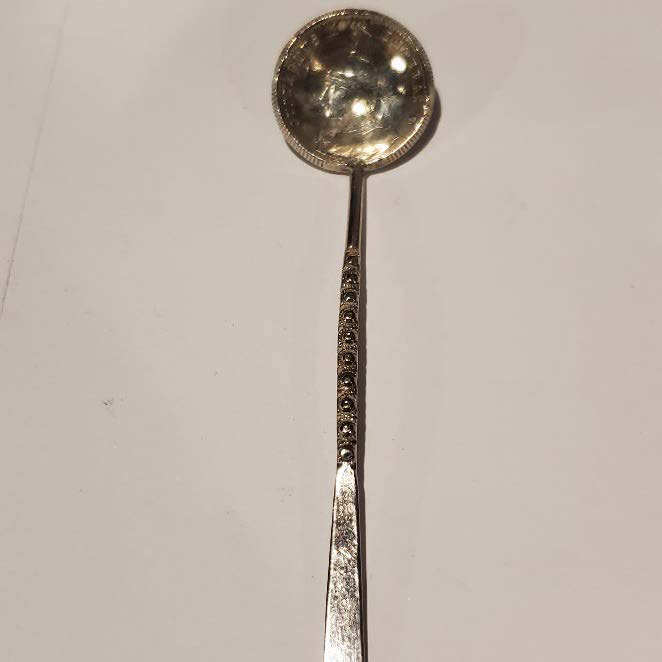
Plenty of companies have produced special, artistic spoons over the course of time, and indeed spoon collecting has become a hobby of its own in the past few decades. Legend has it that spoon collecting started at Mt. Vernon, because visiting folks used to try to take one of the Washington family’s spoons from their silver set as souvenirs; and so, someone thought up the idea of making souvenirs to make this all much more legal. Within this, though, one subset of such collecting has to be spoons made from coins. We’re not talking about modern coins from a year or so ago. Routinely, such coin spoons have been made one at a time, from a classic coin expertly soldered or welded to some ornate handle.
Some personal favorites are those made from the ¼ rupee or ½ rupee silver coins of the old German East Africa colony, now Tanzania, or from any coin sporting the image of Queen Victoria. These always appear to be the tiny sugar spoons a person might have utilized in some sort of custom tea set. They are routinely very attractive, and even have handles that are artistic-looking, too.
Bottles
Supplied image.
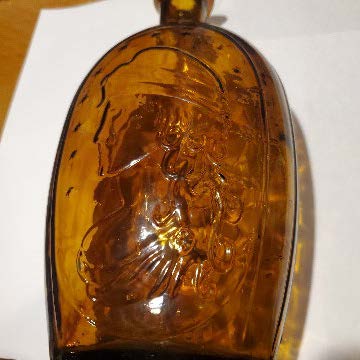
For the person who haunts garage sales, estate sales, or flea markets, there is an enormous array of collectible bottles or other glass containers that are out there, waiting to be found. These include those made with some image of a coin as part of the bottle, as well as those for which a coin has been soldered or glued on.
While bottles like this can be produced today, an informal assessment seems to indicate that such glassware had its heyday sometime right after the Second World War. The bottles marketed then tend to look like they were made for some kind of alcoholic spirits – indeed, special tequila bottles with amazing designs are still sold today (usually full!). It’s a fair bet that more than one company has produced such “coin bottles,” but the Wheaton Glass Company is one that appears to have been a leader in this sort of container, at least several decades ago. The original company is gone, but the successor firms are still out there, pounding out different types of glass. And as long as no one has dropped them, these bottles tend to remain part of someone’s holdings for a very long time.
Anyone opting to put together a set of “coin bottles” today can look for those with a classic United States coin design on them, certainly. But they might easily branch out to others that have, for instance, the Statue of Liberty on them. Or that have the image of a president who is also on one of our coins or paper money. There are a lot of possibilities here for what might be put by a pilsner.
Watches & Clocks
Supplied image.
Much like spoons or bottles, there is a wide variety of different watches that a person might collect that in some way incorporate a coin or other numismatic item. Since wristwatches are often round, as are many clocks, it’s incredibly easy to use a coin as some sort of face for one. Indeed, some are made with actual coins, while others use a cast or minted metal piece as the front or the face.
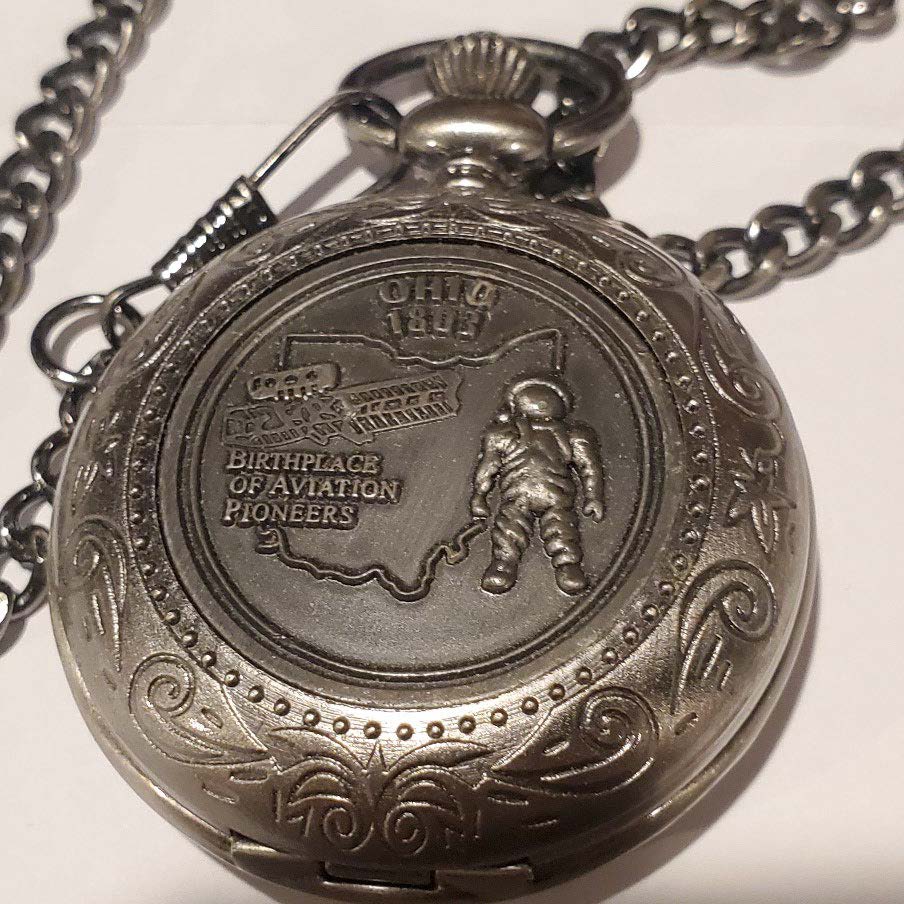
Perhaps more interesting, or at least more historical, are pocket watches with some coin design incorporated into them. Although pocket watches have faded a bit in popularity in the past decades, before the First World War, this was how a man tended to keep time – meaning a wristwatch was considered a piece of women’s jewelry, and thus how a woman kept time. The idea of men wearing some timepiece on their wrist came with that “War to End All Wars,” when every soldier in the trenches waiting for an attack to start needed to have the same time, and to have it in the dark, on a moonless night. Yes, this is honestly where the idea of the glow-in-the-dark wristwatch dial originated before its use today.
But even now, over a century later, a person can purchase a pocket watch, and finding one with a coin design on it is not too hard. It might be an interesting challenge to see if we could assemble a set of pocket watches with each of the States Quarter Reverses on them. The one shown here was for sale for several years at the rest stops on the Ohio Turnpike when it captured my attention.
Church Keys
Supplied image.
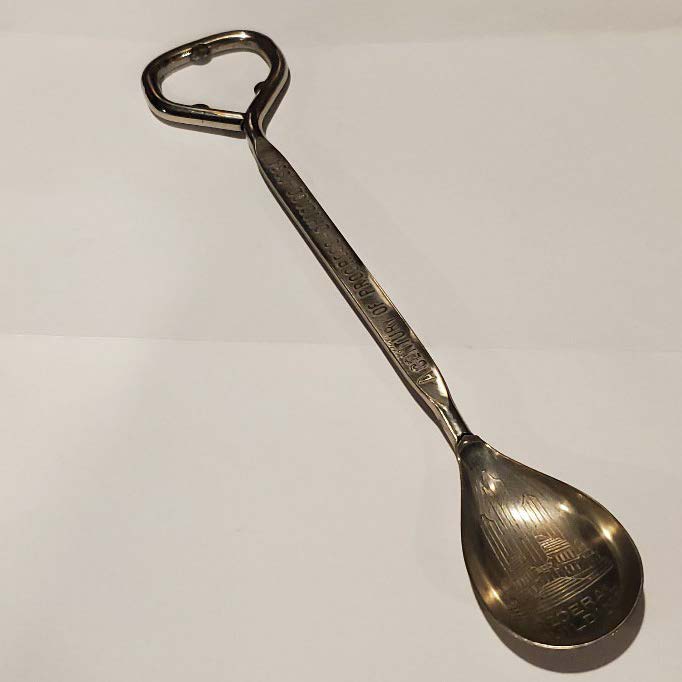
Somewhat like pocket watches fading in popularity over time, the idea of a bottle opener that a person carried – a church key, to use the old term – has faded simply because beverage bottles now often have screw caps, or crimped caps that are made to be removed by hand. Before screw-top soda pop bottles, people had to plan on drinking an entire bottle of soda pop, beer, or other beverage in one sitting, because there was no way to re-close the container. The only other way to re-close a bottle was to force a cork back in top, which is still done with wine.
Without a screw top or a top that twists off by hand, however, the crimped cap and the church key were the norm. Today it’s possible to find an enormous number of bottle openers that have some coin or coin design as part of the handle, simply because the size is right. After all, coins fit conveniently there, too.
Money Clips
Supplied image.
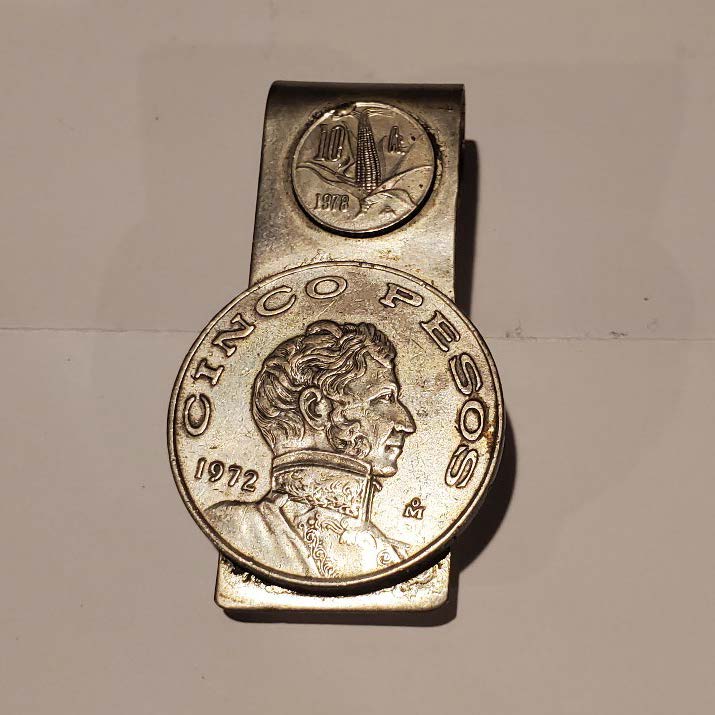
What is more appropriate for a second use of a coin than as part of a money clip? Some clips are as simple as a bent piece of metal, while others have a hinge. It definitely isn’t too hard to solder one or more coins to such a piece of metal. The clip shown here utilizes two coins. There have got to be some that use several.
Curiously, the older the coin-containing money clip, the more it may be worth. That is simply because some of the older coins used as part of such a clip would have been real silver. And in the past year, the price of silver has shot way up.
Others?
Can we take this idea of incorporating a coin into some other item even farther than this? My heavens, yes. We have not even touched on ashtrays, ornamental plates, coffee mugs, coins-made-into-rings, and a hundred other souvenir items that have been found to be a good place to incorporate a coin design. We’ll let others tally up such items, and see just what sort of collections they can make.
Mark Benvenuto has been collecting since the 1960s and became seriously interested in the silver coins of pre-World War II Germany when he was stationed in Mannheim in the 1980s.
Have an interesting numismatic topic you’d like to share with your fellow NOW members?
Send your article to evan.pretzer@protonmail.com today!!!
