NOW Articles Written By Members
For more NOW Articles,
Find us on Facebook

Our Amazing Technicolor Currency
[by Matt Janzen #2082]
Volume 64 - Number 3 - Fall 2026
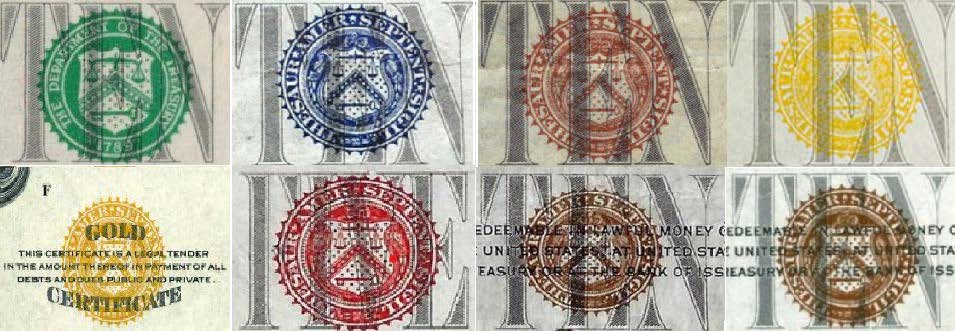
You may have noticed that the notes in your wallet all have green serial numbers and treasury seals. That’s because nearly all circulating United States paper money consists of Federal Reserve notes. Modern notes have some subtle color, but it used to be much different and made up an altogether fascinating rainbow.
Over the years, the United States has issued many different types of currency, creating a wide range of collecting opportunities. Let’s take a look in this article at the various small-size note types issued since 1928, standardizing and their hues.
Federal Reserve Notes
Federal Reserve notes are the primary form of U.S. currency issued today and are legal tender for all debts, public and private. They were authorized by the Federal Reserve Act of 1913, which created the 12 regional Federal Reserve banks. Originally, Federal Reserve notes were backed by gold and redeemable in other forms of lawful money. Today, they are backed by the confidence and credit of the United States government and by financial assets held by the Federal Reserve, including treasury and mortgage-backed securities. Current denominations include the $1, $2, $5, $10, $20, $50, and $100 notes. Higher denominations — $500, $1,000, $5,000, and $10,000 — were discontinued ages ago but are legal.
Federal Reserve notes are easily identified by their green numbers and seals.
Silver Certificates
Silver certificates were first issued in 1878 as a result of the Bland-Allison Act and public demand for silver-backed currency. These certificates allowed the bearer to redeem them for silver dollars or bullion without the inconvenience of transporting large quantities of silver coinage. Redemption for silver coins ended in 1964, while bullion redemption ceased in 1968. Although no longer redeemable for silver, silver certificates remain legal tender and occasionally still turn up in circulation, particularly $1 notes. Small-size silver certificates were issued in $1, $5, and $10 denominations and have blue seals and serial numbers.
Hawaii Overprints
Hawaii notes were first issued on June 25, 1942, in response to the attack on Pearl Harbor. They used the same general designs as the circulating $1 silver certificate and the $5, $10, and $20 Federal Reserve notes of the period, but with two important differences. Most noticeable are the bold black “HAWAII” overprints — two smaller vertical overprints on the face and a large outlined “HAWAII” dominating the back. In addition, the usual blue or green seals and serial numbers were replaced with brown ink in order to more easily stand out.
In the event of a Japanese invasion of Hawaii, the U.S. government could quickly declare the currency invalid. The notes were recalled after the war, and many were destroyed, although surviving examples remain as U.S. legal tender today.
North Africa Notes
North Africa notes were emergency issues released in November 1942 for use in Europe and North Africa campaigns during World War Two. They share the same general appearance as contemporary $1, $5, and $10 silver certificates but are distinguished by bright yellow treasury seals and had a similar Hawaii intent.
Like the Hawaii issues, these notes could have been declared worthless if large quantities had fallen into enemy hands. While the serial numbers remained blue like standard silver certificates, the yellow seal provided swift identification. Because of their distinctive appearance, North Africa notes were not permitted to circulate on the U.S. mainland, and they were in $1, $5, and $10 denominations.
Supplied image.
Gold Certificates
Authorized under the Legal Tender Act of 1863, gold certificates were designed to encourage the deposit of gold into the United States Treasury. They were redeemable in gold coin and payable to the bearer until the United States abandoned the gold standard in 1933. Following that change, private ownership of gold certificates — much like gold coins themselves — became mostly illegal, and many notes were surrendered to the government. Restrictions on ownership were lifted decades later, and today, certificates are legal but are irredeemable.
Small-size gold certificates include the highest denomination ever issued by the United States: the famous $100,000 note. These certificates were never intended for public circulation and were used only for transactions between Federal Reserve banks. Gold certificates were issued in $10, $20, $50, $100, $500, $1,000, $5,000, $10,000, and, finally, the extremely rare $100,000 denomination. They feature distinctive gold-colored serial numbers and seals.
United States Notes
Until relatively recently, United States notes were the longest-running type of U.S. paper money. Often referred to as legal tender notes, they were authorized under the First Legal Tender Act as a form of fiat currency issued directly by the treasury. Although technically redeemable in other forms of U.S. currency — and therefore indirectly redeemable in gold or silver at various times — they eventually became functionally identical to Federal Reserve notes once gold redemption ended in 1933 and silver redemption ceased in 1968. Production stopped in 1969, and the notes largely disappeared from circulation by 1971. Small-size United States notes were issued in $1, $2, $5, and $100 denominations and are identified by their red serial numbers and treasury seals.
National Bank Notes
Small-size national bank notes were issued for individual banks but printed by the federal government. These notes were backed by bonds and deposits purchased by the issuing banks and held by the treasury. Collectors are especially drawn to national bank notes because they prominently display the issuing bank’s name along with its city and state. With more than 14,000 issuing banks nationwide, the series offers nearly endless and colorful collecting possibilities.
By the mid-1930s, however, maintaining title plates and print orders for thousands of individual banks had become cumbersome for the United States Bureau of Engraving and Printing. Combined with the growing dominance of Federal Reserve notes, this led to the end of national bank note production after 1935. National bank notes were issued in $5, $10, $20, $50, and $100 denominations and featured brown serial numbers and treasury seals.
Federal Reserve Bank Notes
Federal Reserve bank notes were emergency issues printed in 1933 during the banking crisis of the Great Depression due to widespread bank failures and public hoarding of currency. They were produced using the same paper stock as national bank notes because of readily available supplies and low demand by national banks. Although they functioned much like Federal Reserve notes, their appearance closely resembled national bank notes. The primary difference is that they identify one of the regional Federal Reserve banks rather than a local bank.
Federal Reserve bank notes were issued in $5, $10, $20, $50, and $100 denominations and also carry brown serial numbers and treasury seals. Today, most people think of U.S. paper money as simply “greenbacks,” but collectors know there is far more variety hidden within the hobby. From the blue seals of silver certificates to the yellow seals of North Africa notes and the bold overprints of Hawaii issues, each type of currency reflects a unique chapter in American financial history. Whether collected by color, denomination, district, or historical significance, these notes continue to offer collectors an epic adventure.
Matt Janzen has been collecting since 1974. He focuses on collecting tokens from Sauk County and small-sized Wisconsin national bank notes. He also runs the WI national bank note census.
Have an interesting numismatic topic you’d like to share with your fellow NOW members?
Send your article to evan.pretzer@protonmail.com today!!!
