NOW Articles Written By Members
For more NOW Articles,
Find us on Facebook

The Rarest U.S. Love Token
[by Tom Casper #0982]
Volume 64 - Number 3 - Fall 2026
Many years ago, when I started collecting love tokens, I decided to collect them on United States coins by type. This is commonly called a type set, and it consists of the major minted coin types of every denomination.
For those who have never done one and/or are generally unfamiliar with numismatic terms, this means there would be a Large Cent, Flying Eagle cent, Indian Head cent, and Lincoln Cent in the cents section. The other coin denominations would be similar and, for gold here, my guidelines turned out to be similar. I included the three types of the gold dollar, the one $3, and Liberty Head and Indian Head types for the Quarter Eagles ($2.50), Half Eagles ($5), Eagles ($10), and for the Double Eagles ($20), I planned on one of the Liberty Head and St. Gaudens designs, so many love.
I soon found out that the Seated Liberty dimes are the most common love token, with the Seated Liberty quarters the next most common. Over the years and with some patience, I have been able to obtain almost all the pieces, except for the St. Gaudens $20. There are a few reasons for their scarcity. They were struck from 1907-33, and this time period was after the fad of love tokens had faded in the United States. As well, in 1933, citizens were ordered to turn in their gold coins. Undoubtedly, some of those were St. Gaudens pieces, made tokens, and melted down to save the economy.
After collecting love tokens for a long time, I wondered if the St. Gaudens was truly the rarest. Could there be a $4 Stella or a 1893-S $1 made into a love token? We’ll never fully know, as new pieces continue to turn up often.
While forming my collection, I came across a scarce gold love token. It is listed and pictured in the Red Book under the “Private and Territorial Gold” heading. The obverse reads “A. Bechtler/1/Dol.” The reverse has an engraved monogram of the letters “WOC.” Shown here is the photo of the coin taken by P.C.G.S before they slabbed it. The coin is just 16 mm, but the images are enlarged to show details you may not be able to see otherwise:
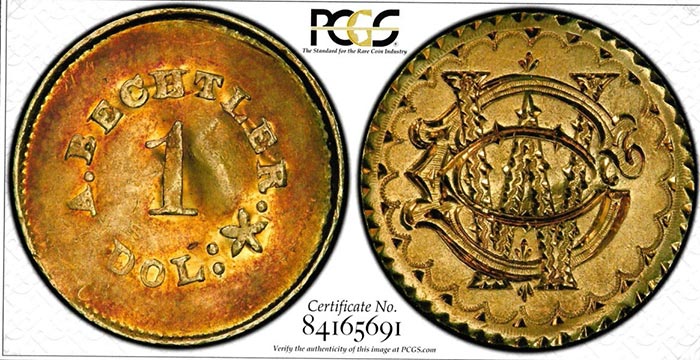
Christopher Bechtler emigrated from Germany to New York City in 1829 with his sons August and Charles and a nephew, Christopher Jr. They then moved to Rutherfordton, N.C., where he established a jewelry and watchmaking business, which was operated from 1830-31. Local miners asked Bechtler to assay their gold dust and convert it into coin. In 1831, he started minting $1, $2.5 and $5 gold coins. In 1840, Christopher Sr. turned over his entire coining business to his son, August. Between 1842 and 1850, August designed and minted $1 pieces bearing his name. These coins weren’t struck by the government, but by assayers, bankers, and other private individuals from the gold the miners were discovering.
These coins were necessary pieces and circulated in isolated areas of the country. They were prompted by the refusal of administrations at the time to provide an adequate medium of exchange in these frontier areas. Thus, the use of gold dust and nuggets was the primary means of commerce, though it was quite inconvenient and wasteful. The solution was converting items like these into coin. Some of the pieces mimicked U.S. gold coins with an image of Liberty on the obverse and an eagle on the reverse. The bulk of these were issued between 1830-83. During this time, the United States government, by and large, looked the other way on private striking because these coins came close enough to official weight and purity; so, in a sense, some of the earliest outsourcing to contractors.
This all came to an end on paper when the Coinage Act of 1864 made private coinage illegal, but the law was not fully enforced until 1883. The mintage of these pieces was low as opposed to what the government issued, but no official records were kept. Since the coins could not be used after 1883, a lot were probably melted. This was the beginning of the love token craze, so very few private coins remained available to be made into love tokens, and thus, the reason for their scarcity on private gold coins, and my wondering about this one.
Tom Casper has been collecting coins since 1953, but in 1967, he changed to collecting tokens and medals. He enjoys history and will occasionally write articles on pieces from his collection.
Have an interesting numismatic topic you’d like to share with your fellow NOW members?
Send your article to evan.pretzer@protonmail.com today!!!
