NOW Articles Written By Members
For more NOW Articles,
Find us on Facebook

What Becomes of the Replaced Artist?
[by Darren Kirby]
Volume 64 - Number 3 - Fall 2026
We see special designs on our money even today, but these usually have to pass a rigorous test that falls within a narrow range of acceptable ideas. While that still leaves plenty of room to create interesting and unique designs, over 100 years ago it was more like the Wild West, especially when it came to commemorative coins and Wisconsin’s design in the classic era.
There was a span of just over 50 years where commemorative half dollars were issued almost like candy, and the things that they were commemorating were not always of a national interest. Take, for example, the commemorative half dollar coin that was issued in 1936 for the centennial celebration of Wisconsin’s territorial government. While we recently had the 50 State Quarters program that celebrated each of the 50 U.S. States, this earlier commemorative coin program seemed a bit more haphazard and was evidenced by Congress acting to stop it back in 1939.
By the time this legislative ban passed, the Wisconsin commemorative half dollar coin had already been authorized, and the quantity struck. A total of 25,015 coins were minted at the Philadelphia mint, with 25,000 struck for the Wisconsin Centennial Commission and an additional 15 that were reserved for the United States Assay Commission. While this doesn't seem like a large number of coins to be struck, it took nearly 20 years for all 25,000 coins to be purchased by those desiring them. In fact, the legislation authorizing these coins was passed in May of 1936, while the centennial celebration was on July 4 of 1936. Needless to say, the coins were not available during the celebration when demand would be highest.
When looking at many different websites for information on who the designer of the Wisconsin commemorative coin is, it will usually be listed as Benjamin Hawkins, who was a New York City sculptor. While it is true that Benjamin Hawkins' design was the one ultimately chosen to be used for the coin, it was not the first design that was submitted and approved. That distinction belongs to David Parsons, who was a student at the University of Wisconsin – Madison in 1936. Parsons prepared designs for the centennial half dollar, and they were approved by the Wisconsin Centennial Commission in April of 1936. Part of the restrictions that were on all designs was that the seal of the Wisconsin Territory be used on one side, and a badger (the state animal) be portrayed on the coin’s reverse.
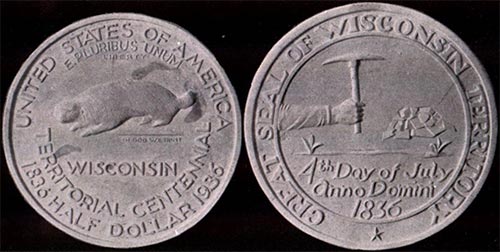
Parsons’ unused concept. Image via The Numismatist (June 1936), which did not publish copyright notices on content until 1958, according to Wikimedia Commons.
The government ultimately rejected the designs offered by Parsons. They claimed that the models were poorly executed and in very high relief. Subsequently, this meant that the design could not be used to mint coins. The Wisconsin Centennial Commission then asked the United States Treasury Department for the name of a suitable artist, and they were given Benjamin Hawkins. He was given just three weeks to submit finished models, which he did on June 3, 1936, with approval two days later.
David Parsons' design featured a person's arm holding a pickaxe next to a pile of some mineral, possibly iron ore, on the obverse. The words “4th Day of July, Anno Domini, 1836” were inscribed beneath this image, and the words “Great Seal of Wisconsin Territory” were in a ring around this entire image. The reverse of the coin featured a badger in the middle of the field with the words “Territorial Centennial, 1836 – Half Dollar – 1936” beneath the badger. Text saying “United States of America, E. Pluribus Unum” was above the badger. The design that Hawkins submitted was not vastly different from what David Parsons crafted, though it is said that Benjamin was only working from the territorial seal and it was not known if he had ever seen David's proposed images for what the coin should finally be.
While Benjamin Hawkins gets the credit for the coin's design, and an “H” is found underneath his badger rendering, there is little mention of him doing other work for the federal government, either with the mint or other departments. And what of David Parsons and his failed attempt at providing designs for the coin celebrating Wisconsin’s territorial century? It turns out that he maintained a studio in Stoughton, Wisconsin, for many years. He won many prizes in the 1930s and 1940s for his sculptures and other works. He also designed two different versions of the 1968 Houston Distinguished Visitors Medal that bear his initials under the wing of a bird in flight. During World War Two, he was a surgical assistant for plastic surgery in the United States Army and assisted many wounded veterans, and he died in California in 2005, with no images of him existing online.
While it was admirable for the Wisconsin Centennial Commission to want to utilize some homegrown artist to design the commemorative coin, his inexperience with the coining process was likely the cause for his design to be rejected by the mint. David Parsons isn't usually thought of when it comes to this coin, and the coin itself isn't one that is necessarily in high demand, even today. Coming across a commemorative coin from this era is a surprising find, as most were held onto by those who purchased them, even though they were and still are legal tender. If you ever get a chance to see one of these 25,000 coins marking Wisconsin’s pre-statehood past, think of the hard work a college student once put in on a design that was rejected, but wasn't far off from what was ultimately accepted by the mint.
Darren Kirby is a professional writer and amateur numismatist. He lives in the Chippewa Valley. You can learn more about him and his writings at his website.
Have an interesting numismatic topic you’d like to share with your fellow NOW members?
Send your article to evan.pretzer@protonmail.com today!!!
